
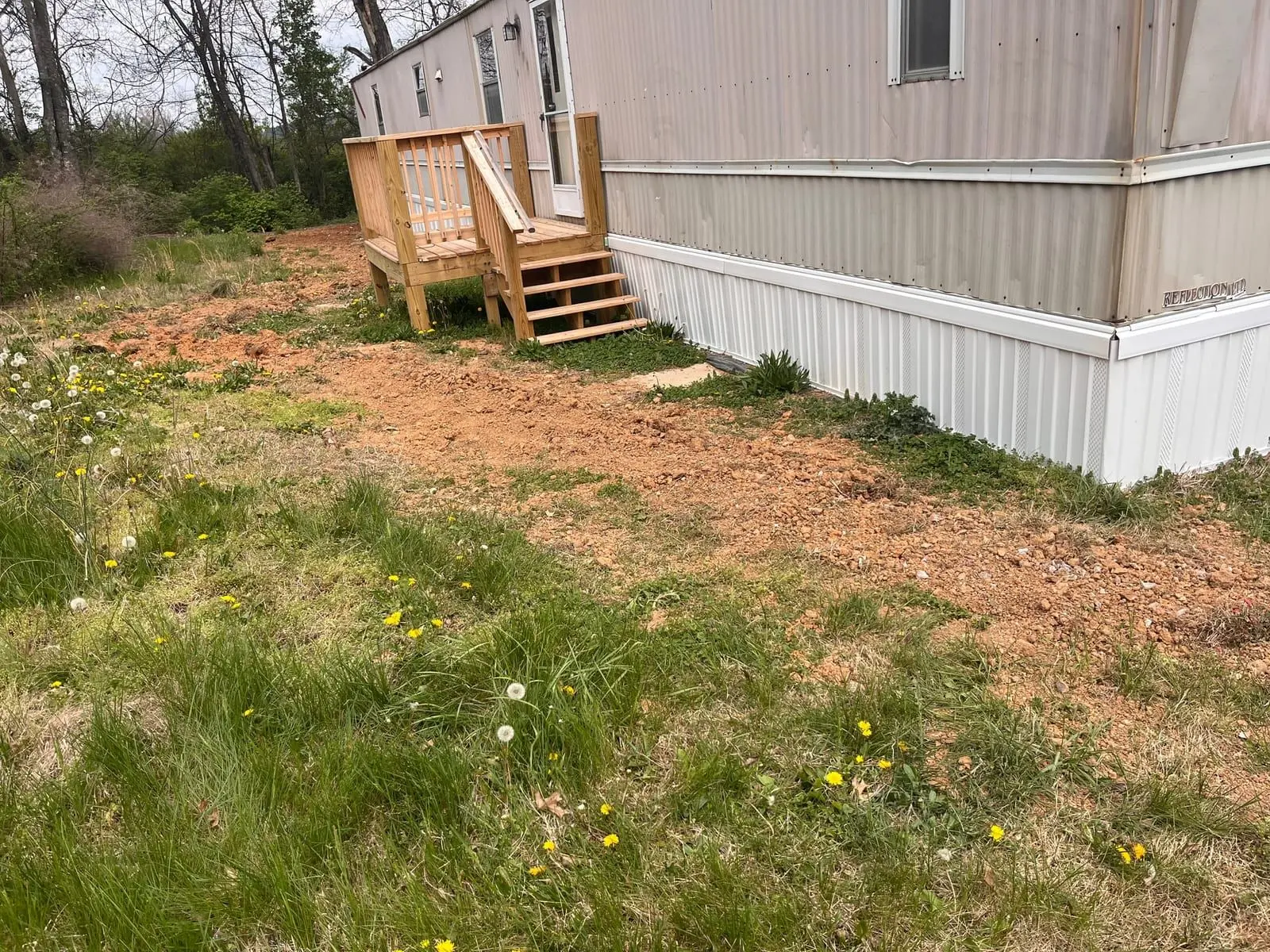
Most drainage problems don’t start with standing water. They start with a homeowner noticing the same wet spot after every rain.
Then the grass starts thinning. The mulch washes away. The mower leaves ruts. Eventually, the water starts moving toward a foundation, driveway, retaining wall, or patio, and what began as an annoyance becomes an expensive problem.
One of the biggest misconceptions we encounter throughout Blount County is that all drainage systems do the same thing. Homeowners often call asking for a French drain because that’s the only drainage term they’ve heard before. In reality, a French drain may be the perfect solution—or completely ineffective—depending on what’s causing the problem.
We install drainage systems across East Tennessee every year, and the first step is almost always identifying whether you’re dealing with groundwater, surface water, concentrated runoff, or a combination of all three. Once you understand the source of the problem, choosing the right solution becomes much easier.
Not all water problems are the same
Before choosing a drainage solution, you need to understand what type of water you’re trying to manage.
Many drainage failures happen because the wrong system was installed for the wrong problem.
For example, water flowing across the surface of your yard after a storm behaves very differently than groundwater slowly saturating soil beneath the surface. A system designed for one may do very little for the other.
Most residential drainage issues fall into one of three categories:
- Surface water moving across the ground
- Groundwater saturating the soil below
- Concentrated runoff from roofs, driveways, or slopes
The good news is that every one of these problems has a solution. The challenge is matching the solution to the source.
When a French drain makes sense
French drains are one of the most misunderstood drainage systems available.
A true French drain consists of a perforated pipe surrounded by drainage stone and wrapped in geotextile fabric. Its purpose is to intercept groundwater beneath the surface and move it away before it becomes a problem.
French drains work particularly well for:
- Constantly wet yards
- Soggy areas that stay wet for days after rain
- Water collecting behind retaining walls
- Hillside seepage
- Foundation drainage concerns
What French drains do not do particularly well is handle large volumes of water flowing across the surface.
If a heavy rain creates a visible stream running through your yard, a French drain alone may not solve the problem.
French drains are best at collecting water before it reaches the surface, not after.
When a catch basin is the better choice
A catch basin is designed to capture concentrated surface water.
Think of it as a collection point. Water flows into the basin, debris settles out, and the water is then carried away through solid pipe.
Catch basins excel when:
- Downspouts discharge large volumes of water
- Driveways funnel runoff
- Hard surfaces concentrate flow
- Water naturally converges into low spots
One of the biggest advantages of a catch basin is its ability to handle sudden surges of water during heavy storms.
Unlike a French drain, which collects water gradually through perforations, a catch basin can immediately accept large amounts of runoff.
The drawback is that catch basins only work where water naturally flows toward them. They won’t solve widespread saturation issues across an entire yard.
Surface drains are often the unsung hero
Surface drains don’t get discussed as often as French drains, but they’re incredibly effective.
A surface drain is designed to intercept water before it has an opportunity to travel across your property. These systems are often installed along patios, sidewalks, driveways, pool decks, and building foundations.
In many cases, surface drains are the first line of defense.
They work best when:
- Water consistently flows in predictable paths
- Hardscapes create runoff issues
- Erosion is occurring
- Water threatens structures
One mistake we frequently see is homeowners trying to solve a surface-water problem entirely underground. If the water is already moving across the surface, it often makes sense to capture it there before it becomes a bigger issue.
The best solution is often a combination
Most significant drainage projects don’t rely on a single system.
A property may need:
- Surface drains near structures
- Catch basins at collection points
- French drains in saturated areas
- Solid pipe to carry water away
- Grading improvements to improve flow
In fact, many of the most successful drainage systems we install throughout East Tennessee use multiple components working together.
For example, a yard may have groundwater seepage near a retaining wall and surface runoff from a nearby driveway. Solving only one problem leaves the other untouched.
Drainage is less about individual products and more about managing water as a complete system.
When to call us
Some drainage issues are simple enough for a homeowner to tackle.
Extending a downspout, correcting minor grading, or cleaning an existing catch basin can often be handled without professional help.
Where we recommend calling a professional:
- Standing water remains more than 24–48 hours after rain
- Water is approaching your home’s foundation
- Erosion is actively removing soil
- Retaining walls show signs of pressure or failure
- Multiple drainage problems exist simultaneously
- Previous drainage fixes haven’t worked
- Significant excavation may be required
At Lawngevity, we install French drains, catch basins, surface drainage systems, grading corrections, retaining wall drainage, and complete water-management solutions — from French drain installs in Alcoa to full property regrades — throughout Blount County and surrounding East Tennessee communities.
The biggest mistake homeowners make is waiting until water damages something expensive. Water always follows the path of least resistance. Our job is making sure that path doesn’t run through your property.
The bottom line
The best drainage system isn’t the one you’ve heard of—it’s the one designed for the problem you’re actually facing. Whether that’s a French drain, a catch basin, a surface drain, or a combination of all three, understanding how water moves across your property is the first step toward solving it permanently.
Tagged