
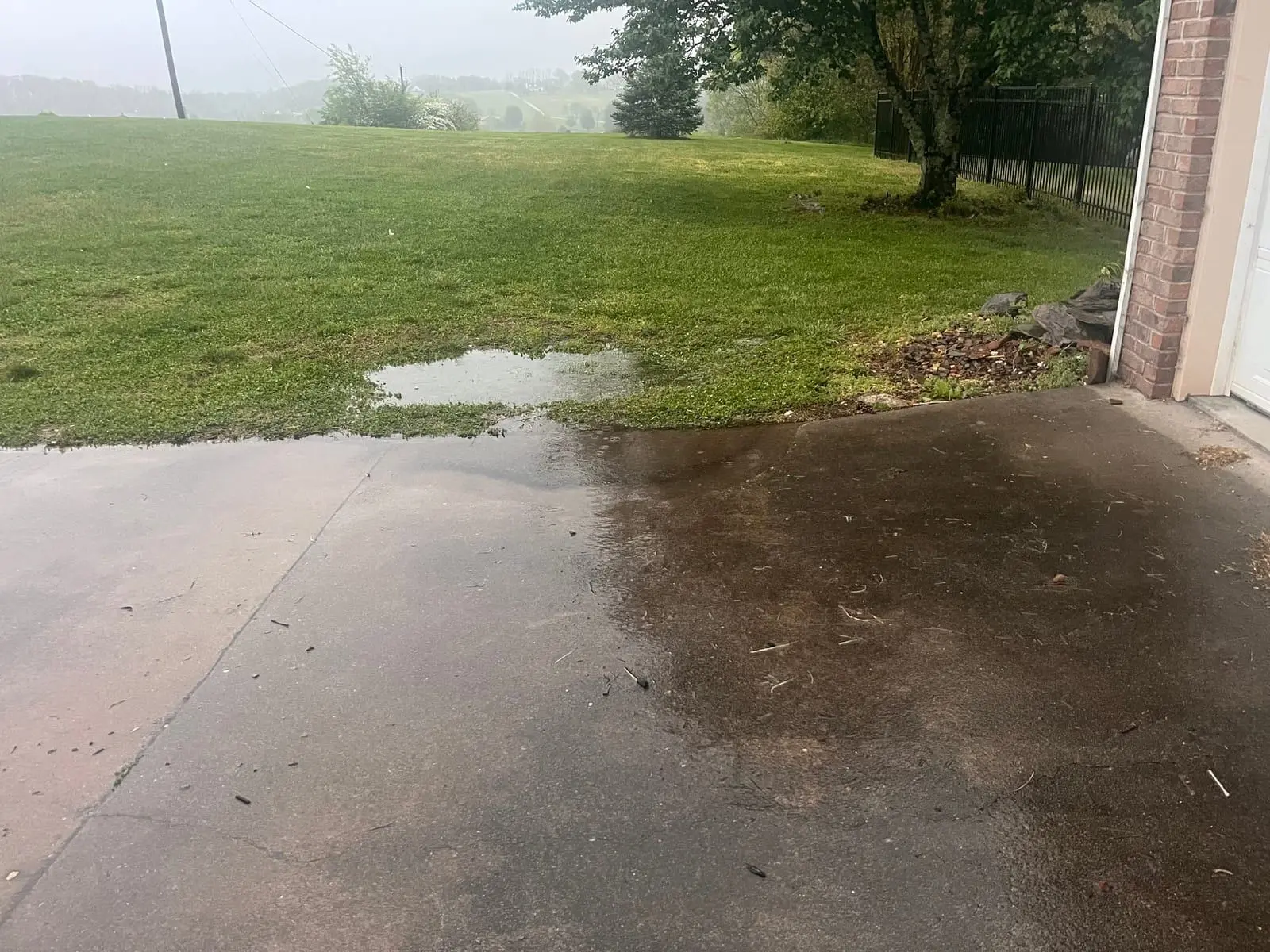
Most drainage problems start small enough that homeowners ignore them.
A puddle that takes too long to dry. Mulch washing out during storms. Water creeping toward the crawlspace after heavy rain. A soft spot in the yard you keep mowing around. Then one season later, the retaining wall starts leaning, the crawlspace smells musty, erosion channels appear across the lawn, or water starts finding its way into places it absolutely should not be.
We see this constantly across Blount County and East Tennessee. One of the biggest misconceptions homeowners have is thinking drainage problems are cosmetic. Most of the serious issues we deal with started as “minor annoyances” that were left alone too long.
Water is patient. It does not need one catastrophic storm to damage a property. It just needs time and the wrong path.
The most expensive drainage problem
The single biggest drainage issue we see in East Tennessee is water collecting near foundations and crawlspaces.
A surprising number of homes in Blount County have downspouts dumping directly beside the house, negative grading that slopes back toward the structure, or low areas that trap runoff after storms. Combined with East Tennessee’s clay-heavy soil, that water has nowhere to go.
The result:
- Crawlspace moisture and humidity
- Mold and mildew growth
- Rotting wood and insulation damage
- Foundation settling
- Cracking concrete
- Persistent musty odors inside the home
Clay soil makes this worse because it expands when saturated and contracts when dry. Over time, that movement can place stress on foundations, sidewalks, patios, and retaining walls.
A lot of homeowners think the danger starts when water enters the house. In reality, the damage usually starts long before that.
Why hillsides become washouts
East Tennessee properties deal with elevation changes constantly. Sloped yards may look beautiful, but unmanaged water gains speed extremely fast when moving downhill.
We regularly see:
- Washed-out mulch beds
- Exposed roots
- Gullies forming through lawns
- Gravel displaced into driveways
- Fence posts loosening
- Hillsides beginning to destabilize
- Retaining walls failing from hydrostatic pressure
The dangerous part is that erosion usually starts subtly. A homeowner notices a little rut after a storm, throws down seed or dirt, and assumes the problem is fixed. Meanwhile, water keeps cutting deeper every season.
One major storm can accelerate years of slow erosion damage in a single night.
Why DIY drainage often fails
Drainage is one of the most misunderstood parts of landscaping because a lot of fixes look correct while actually creating larger hidden problems.
We frequently see:
- French drains installed without enough pitch
- Corrugated pipe crushed under shallow burial
- Pop-up emitters placed where water immediately returns downhill
- Dry creek beds installed with no actual drainage function
- Retaining walls built without drainage stone or fabric
- Water redirected directly onto neighboring properties
- Downspouts tied into systems too small to handle roof volume
The result is usually one of two things: the system does nothing, or the water problem simply moves somewhere worse.
Good drainage work is less about the pipe itself and more about understanding water movement across the entire property. Every yard has a high point, low point, flow path, saturation zone, and collection area. If those are misunderstood, even expensive drainage installs can fail.
The goal is not just to move water. The goal is to move it safely, predictably, and permanently.
When heavy rain becomes an emergency
Some drainage issues can wait until next season. Others should move to the top of your priority list immediately.
These are usually signs that the water volume, pressure, or saturation level has already exceeded what the property can safely handle.
Drainage problems almost always get more expensive with time. Water rarely damages things all at once. It weakens them slowly until failure finally becomes visible.
When to call us
Some drainage problems absolutely can be handled by a homeowner.
Simple downspout extensions, small grading touch-ups, or minor surface runoff issues are often manageable if you have the time, equipment, and ability to move soil correctly.
Where most homeowners should seriously consider professional help:
- Water near the foundation or crawlspace
- Large-scale runoff from hills or neighboring properties
- Erosion that keeps returning
- Retaining wall drainage
- Standing water affecting large areas
- Drainage involving sidewalks, driveways, or hardscapes
- Situations requiring trenching near utilities or irrigation
- Multi-point drainage systems with catch basins or buried pipe
This is especially true across Blount County and the rest of East Tennessee, where our terrain and clay soil make water behavior unpredictable compared to flatter regions.
At Lawngevity, drainage and French drains are one of our core services. We handle:
- French drains
- Catch basin systems
- Downspout drainage
- Surface water diversion
- Swales and grading
- Drainage correction around retaining walls
- Erosion mitigation
- Dry creek bed systems
- Property drainage evaluations
Good drainage work protects everything else on the property. Bad drainage quietly destroys it.
The bottom line
Most serious drainage problems do not begin as disasters. They begin as warning signs homeowners learn to live with for too long. In East Tennessee, controlling water early is almost always cheaper than repairing what it damages later.
Tagged